

01
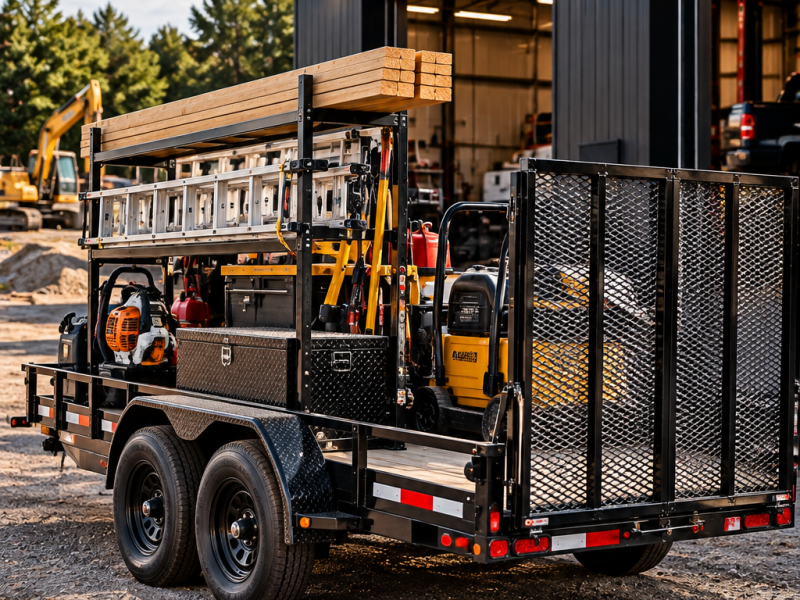
Storage & Shelving
Modular aluminium shelving and sealed drawer banks rated for load and vibration.
- Load-rated aluminium shelving
- Sealed drawer banks
- Bin and parts walls
TRAILER UPFITTING · BUILT FOR THE JOB
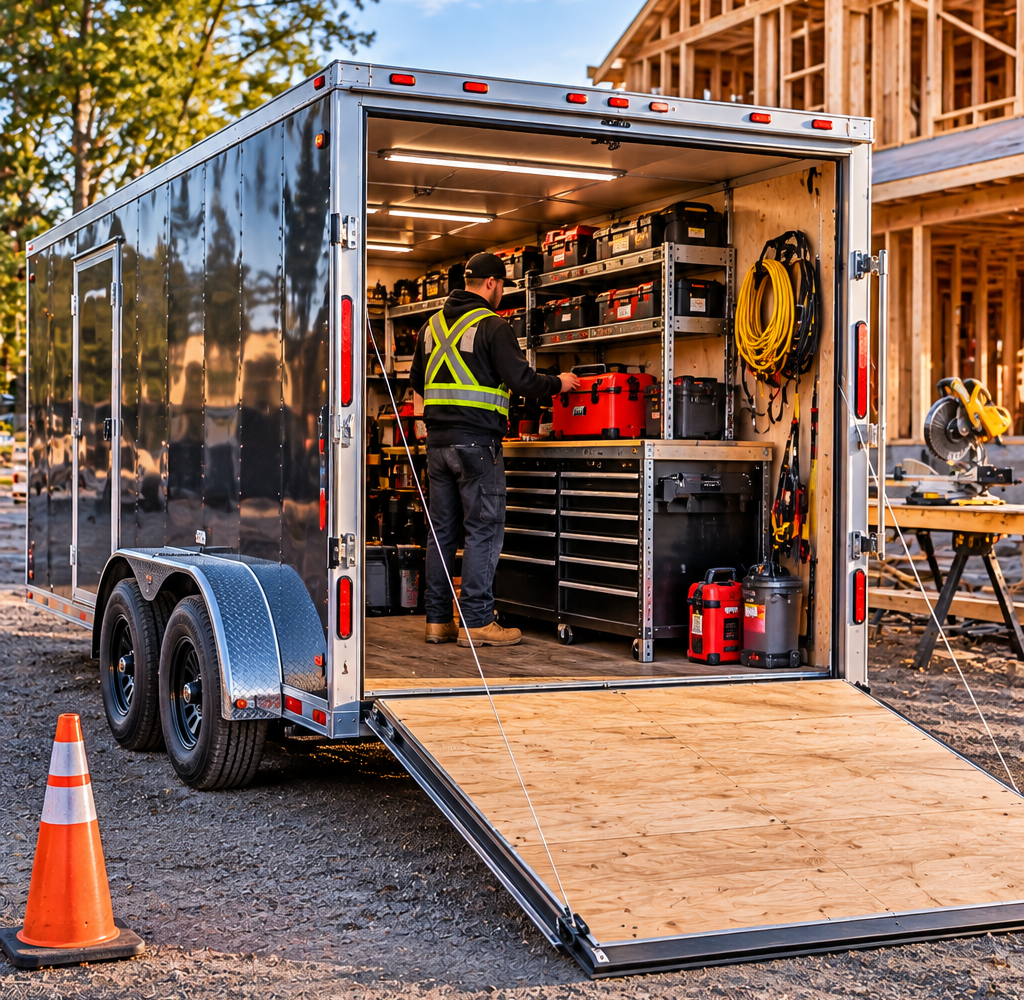
We transform enclosed trailers into functional, hardworking spaces built around your business. From transporting valuable equipment to creating a fully customized mobile workspace, every upfit from our Oakville shop is designed to maximize efficiency, organization, and durability. Whatever your trade, we build practical solutions that keep your equipment protected and your business moving.
What we install
01
Modular aluminium shelving and sealed drawer banks rated for load and vibration.
02
Steel, mesh and composite bulkheads, fitted to your cab profile and sized to the load you carry.
03
Inverters, secondary batteries, interior LED runs and exterior work lighting.
04
Ladder and pipe racks, roof access, plus decals and full graphics applied in-house.
Financing
Straight answers
Yes. We can help create a fully customized mobile workspace that keeps your tools organized, equipment accessible, and business operating efficiently wherever the job takes you.
Yes. We can assess protective flooring, wall liners, and other interior finishes designed to withstand regular use and help protect the trailer from everyday wear.
Yes. Cargo management systems can provide flexible mounting and tie-down options to help secure equipment and materials during transportation.
Added equipment increases the trailer's empty weight and reduces its available cargo capacity. We consider rated weight limits, axle capacities, and load distribution when planning your build.
Pricing depends on your trailer's size, the equipment selected, and the complexity of the project. Our team can review your requirements and prepare a customized quote.
Not the right fit? Try a sibling
——— Let's Talk
Tell us about the job and a builder will get back to you within one business day. Prefer to talk it through? Call us direct.
(905) 845-0770670 Fourth Line, Oakville, ON · Quotes within 1 business day
Request a Consult
About NMT Outfitters
NMT Auto Service in Oakville helps customers plan an enclosed cargo trailer around the way it is actually used. Whether the trailer carries tools, equipment, materials, or changing loads, NMT can help you approach the upfitting around cargo flow, access, usable space, existing equipment, and business or fleet requirements instead of treating the project as a disconnected list of additions.
The most useful enclosed trailer accessories support a clear purpose. Start by understanding what goes into the trailer, what needs frequent access, which areas must stay open, and what parts of the current setup already work well. That gives the project a practical direction before individual accessory or upfitting needs are discussed.
Every enclosed cargo trailer should be planned around the cargo and routine it supports. Before thinking about individual additions, identify what stays inside most of the time, what changes from job to job, what needs to be reached quickly, and how much open space must remain for loading and unloading.
Start with:
This establishes the practical needs of the trailer without assuming that every available wall or floor area needs to be filled.
List the items that are present on a normal day, then separate them from cargo that appears only for certain jobs or uses. Everyday equipment may need a predictable location, while occasional or larger loads may make flexible floor space more valuable.
The goal is to understand which parts of the trailer support the same routine every day and which areas need to adapt. That distinction gives later outfitting decisions a reason instead of turning the interior into a permanent layout that may not suit changing work.
Review the trailer from the point of entry inward:
Think about how people and cargo move through these spaces. A useful layout should make common tasks easier without creating obstacles for the loads the trailer still needs to carry.
The right balance of enclosed trailer accessories depends on which functions stay consistent and which change over time. Some areas may support regular equipment or organization, while others need to remain open for different cargo. Planning both fixed and flexible space helps keep the trailer useful for more than one routine.
Ask:
Start with the functions that matter on most trips. These may include organization, access, cargo positioning, protection, or another recurring requirement.
Keep the focus on the result rather than assuming a particular product. If the problem is poor access, define what needs to become easier to reach. If the problem is lost cargo space, identify what is occupying that space before adding something new.
A trailer may carry one type of load during the week and something very different later. Avoid planning every available area around today’s cargo if part of the trailer needs to remain adaptable.
Flexible space can be especially important for businesses whose equipment or materials change from job to job. It can also help personal-use trailers accommodate different activities without requiring the entire interior to be reorganized.
When working with enclosed trailers upfitters, describe the actual loading and unloading routine before discussing additions. The order in which cargo enters, where it stays, and what needs to come out first can reveal access problems that are easy to miss when the trailer is considered only as an empty interior.
Walk through questions such as:
Mentally trace a typical trip from loading to unloading. Note where cargo enters, where it is positioned, what needs to be reached during use, and what remains inside until the end of the day.
This simple exercise can identify unnecessary movement, blocked access, or areas where the current setup makes routine work harder. It also gives NMT better context for discussing the trailer’s outfitting needs.
Separate high-frequency items from equipment that can remain farther inside. If something is needed repeatedly, its position should not require moving several other items first.
This is a planning principle rather than a prescription for a specific storage system. The objective is to make access match the way the trailer is actually used.
Each addition is more useful when it addresses a defined need. NMT Auto Service provides aftermarket accessories through its broader upfitting offering, so the best starting point is to explain the current problem, the desired result, and the trailer configuration you already have.
Organize the discussion around needs such as:
Learn more about NMT’s fleet upfitting and aftermarket accessories when preparing your project.
Before considering a specific addition, ask:
A clear result makes it easier to evaluate whether a proposed addition belongs in the build.
Before changing an enclosed cargo trailer, record the current configuration. Note existing equipment, permanent installations, available wall and floor space, entry points, and the areas that are already working effectively.
Keeping useful parts of the current layout can be just as important as identifying what needs to change. The objective is not to rebuild the trailer from scratch if the existing setup already supports part of the workflow.
For businesses comparing enclosed trailers upfitters, the planning process should account for the role of each trailer instead of assuming every unit needs an identical setup. NMT Auto Service provides fleet maintenance and upfitting and lists aftermarket accessories among its Fleet/Wholesale capabilities.
Business users should identify:
For a single trailer, start with the operator’s normal routine. Document what is carried, what is accessed most often, how much open space is needed, and which parts of the current layout create problems.
This keeps the project centred on one trailer’s actual job rather than applying a generic commercial setup.
For several trailers, document each unit first:
Then identify what is genuinely shared across the group. NMT’s fleet maintenance and upfitting offering provides a relevant starting point for broader commercial vehicle requirements.
An enclosed cargo trailer may serve a different role as equipment, work, or business requirements change. Before making the current layout more permanent, separate long-term needs from temporary ones and identify which areas should stay adaptable.
Consider:
Do not replace useful parts of the existing setup simply because the trailer’s role is changing. Identify the areas that already support loading, access, and cargo use effectively.
Then focus the project on the shortcomings that have actually appeared. This keeps the build practical and avoids unnecessary changes.
Look for problems such as:
These issues provide a clearer basis for discussing changes than a general request to add more equipment.
A build brief turns a general request for enclosed trailer accessories into a clearer discussion about the actual trailer. It also helps separate current problems from changes you may want later. Enclosed trailers outfitters can work from more useful information when the current layout, cargo, access needs, and desired changes are identified before the project begins.
Bring:
Contact NMT Auto Service in Oakville with this information to start discussing the trailer’s upfitting needs.
Start with what the trailer normally carries, how cargo enters and exits, what needs frequent access, and how much space must remain flexible. Then review the existing configuration and identify the specific problem you want the outfitting to solve before considering individual additions.
Prioritize the needs that affect everyday use first. That may mean improving organization, access, protection, cargo space, or flexibility. The right order depends on the current trailer and the work it needs to support rather than a universal accessory list.
Review what is already installed and keep the parts that still support the new role. Then document the new cargo, access requirements, available space, and areas that create problems. Build the next changes around those gaps rather than automatically replacing the entire setup.
NMT Auto Service provides fleet maintenance and upfitting along with aftermarket accessories. For business or fleet use, document each trailer’s role, current setup, typical cargo, and planned changes so shared and vehicle-specific requirements can be discussed separately.
NMT Auto Service in Oakville can help you plan an enclosed cargo trailer around its current configuration, cargo, access requirements, and intended use. Bring the details of what is already installed and the problems you want to solve. For customers comparing enclosed trailers upfitters, NMT also provides broader fleet maintenance, upfitting, and aftermarket-accessory capabilities.
The most useful enclosed cargo trailer plan starts with the cargo and daily workflow. Understand what enters the trailer, what needs frequent access, which areas should remain open, and what already works before deciding what to change. NMT Auto Service in Oakville can help connect those needs with relevant outfitting and accessory requirements. Contact NMT or call 905-845-0770 to discuss the trailer and the way you need it to work.
Etobicoke
Hamilton
Mississauga
Oakville
Mechanical Trades
Construction & Site
Grounds & Seasonal
Service & Specialty
Delivery & Logistics
Public & Emergency